Punk rock
From Wikipedia, the free encyclopedia
Jump to: navigation, search
This article is about the music genre. For the play of the same name, see Punk Rock (play).
Punk rock
Stylistic origins Rock and roll • folk • rockabilly • ska • surf rock • garage rock • glam rock • pub rock • protopunk
Cultural origins Mid-1970s, United States, United Kingdom, and Australia
Typical instruments Vocals • electric guitar • bass • drums
Mainstream popularity Topped charts in UK during late 1970s. International commercial success for pop punk and ska punk, mid-1990s–2000s.
Derivative forms New Wave • post-punk • gothic rock • alternative rock • grunge • emo
Subgenres
Anarcho-punk • art punk • Christian punk • crust punk • garage punk • glam punk • hardcore punk • oi! • Riot Grrrl • skate punk
(complete list)
Fusion genres
2 Tone • anti-folk • avant-punk • Celtic punk • Chicano punk • cowpunk • deathrock • folk punk • Gaelic punk • Gypsy punk • pop punk • psychobilly • punk blues • punk jazz • ska punk • synthpunk
Regional scenes
Argentina • Australia • Basque Country • Belgium • Brazil • California • France • Germany • Spain • Uruguay • Yugoslavia
Local scenes
Brisbane • Toronto
Other topics
Protopunk • DIY ethic • First wave punk • Queercore • Punk fashion • Punk ideologies • Punk movies • Punk fanzines • Punk subculture • Punk timeline • Second wave punk • Straight Edge • List of punk bands • Punk rock subgenres
Punk rock is a rock music genre that developed between 1974 and 1976 in the United States, the United Kingdom, and Australia. Rooted in garage rock and other forms of what is now known as protopunk music, punk rock bands eschewed perceived excesses of mainstream 1970s rock. Punk bands created fast, hard-edged music, typically with short songs, stripped-down instrumentation, and often political, anti-establishment lyrics. Punk embraces a DIY ethic; many bands self-produced recordings and distributed them through informal channels.
By late 1976, bands such as the Ramones, in New York City, and the Sex Pistols and The Clash, in London, were recognized as the vanguard of a new musical movement. The following year saw punk rock spreading around the world, and it became a major cultural phenomenon in the United Kingdom. For the most part, punk took root in local scenes that tended to reject association with the mainstream. An associated punk subculture emerged, expressing youthful rebellion and characterized by distinctive styles of clothing and adornment and a variety of anti-authoritarian ideologies.
By the beginning of the 1980s, faster, more aggressive styles such as hardcore and Oi! had become the predominant mode of punk rock. Musicians identifying with or inspired by punk also pursued a broad range of other variations, giving rise to post-punk and the alternative rock movement. By the turn of the century, pop punk had been adopted by the mainstream, as bands such as Green Day and The Offspring brought the genre widespread popularity.
Contents
[hide]
1 Characteristics
1.1 Philosophy
1.2 Musical and lyrical elements
1.3 Visual and other elements
2 Pre-history
2.1 Garage rock and mod
2.2 Protopunk
2.3 Etymology
3 Early history
3.1 North America
3.1.1 New York City
3.1.2 Other U.S. cities
3.2 Australia
3.3 United Kingdom
4 Second wave
4.1 North America
4.2 United Kingdom
4.3 Australia
4.4 Rest of the world
5 Schism and diversification
5.1 New Wave
5.2 Post-punk
5.3 Hardcore
5.4 Oi!
5.5 Anarcho-punk
5.6 Pop punk
5.7 Other fusions and directions
6 Legacy and later developments
6.1 Alternative rock
6.2 Emo
6.3 Queercore and riot grrrl
7 Revival
8 In the mainstream
9 See also
10 References
11 Sources
12 External links
[edit] Characteristics
[edit] Philosophy
The Ramones' 1976 debut album laid down the musical "blueprint for punk",[1] while its cover image had a similarly formative influence on punk visual style.[2]
The first wave of punk rock aimed to be aggressively modern, distancing itself from the bombast and sentimentality of early 1970s rock.[3] According to Ramones drummer Tommy Ramone, "In its initial form, a lot of [1960s] stuff was innovative and exciting. Unfortunately, what happens is that people who could not hold a candle to the likes of Hendrix started noodling away. Soon you had endless solos that went nowhere. By 1973, I knew that what was needed was some pure, stripped down, no bullshit rock 'n' roll."[4] John Holmstrom, founding editor of Punk magazine, recalls feeling "punk rock had to come along because the rock scene had become so tame that [acts] like Billy Joel and Simon and Garfunkel were being called rock and roll, when to me and other fans, rock and roll meant this wild and rebellious music."[5] In critic Robert Christgau's description, "It was also a subculture that scornfully rejected the political idealism and Californian flower-power silliness of hippie myth."[6] Patti Smith, in contrast, suggests in the documentary 25 Years of Punk that the hippies and the punk rockers were linked by a common anti-establishment mentality.
Throughout punk rock history, technical accessibility and a DIY spirit have been prized. In the early days of punk rock, this ethic stood in marked contrast to what those in the scene regarded as the ostentatious musical effects and technological demands of many mainstream rock bands.[7] Musical virtuosity was often looked on with suspicion. According to Holmstrom, punk rock was "rock and roll by people who didn't have very much skills as musicians but still felt the need to express themselves through music".[5] In December 1976, the English fanzine Sideburns published a now-famous illustration of three chords, captioned "This is a chord, this is another, this is a third. Now form a band."[8] The title of a 1980 single by the New York punk band Stimulators, "Loud Fast Rules!", inscribed a catchphrase for punk's basic musical approach.[9]
Some of British punk rock's leading figures made a show of rejecting not only contemporary mainstream rock and the broader culture it was associated with, but their own most celebrated predecessors: "No Elvis, Beatles or the Rolling Stones in 1977", declared The Clash song "1977".[10] The previous year, when the punk rock revolution began in Great Britain, was to be both a musical and a cultural "Year Zero".[11] Even as nostalgia was discarded, many in the scene adopted a nihilistic attitude summed up by the Sex Pistols slogan "No Future";[3] in the later words of one observer, amid the unemployment and social unrest in 1977, "punk's nihilistic swagger was the most thrilling thing in England."[12] While "self-imposed alienation" was common among "drunk punks" and "gutter punks", there was always a tension between their nihilistic outlook and the "radical leftist utopianism"[13] of bands such as Crass, who found positive, liberating meaning in the movement. As a Clash associate describes singer Joe Strummer's outlook, "Punk rock is meant to be our freedom. We're meant to be able to do what we want to do."[14]
The issue of authenticity is important in the punk subculture—the pejorative term "poseur" is applied to those who associate with punk and adopt its stylistic attributes but are deemed not to share or understand the underlying values and philosophy. Scholar Daniel S. Traber argues that "attaining authenticity in the punk identity can be difficult"; as the punk scene matured, he observes, eventually "[e]veryone got called a poseur".[15]
[edit] Musical and lyrical elements
Punk rock bands often emulate the bare musical structures and arrangements of 1960s garage rock.[16] Typical punk rock instrumentation includes one or two electric guitars, an electric bass, and a drum kit, along with vocals. Punk rock songs tend to be shorter than those of other popular genres—on the Ramones' debut album, for instance, half of the fourteen tracks are under two minutes long. Most early punk rock songs retained a traditional rock 'n' roll verse-chorus form and 4/4 time signature. However, punk rock bands in the movement's second wave and afterward have often broken from this format. In critic Steven Blush's description, "The Sex Pistols were still rock'n'roll...like the craziest version of Chuck Berry. Hardcore was a radical departure from that. It wasn't verse-chorus rock. It dispelled any notion of what songwriting is supposed to be. It's its own form."[17]
Punk rock vocals sometimes sound nasal,[18] and lyrics are often shouted instead of sung in a conventional sense, particularly in hardcore styles.[19] The vocal approach is characterized by a lack of variety; shifts in pitch, volume, or intonational style are relatively infrequent.[20] Complicated guitar solos are considered self-indulgent and unnecessary, although basic guitar breaks are common.[21] Guitar parts tend to include highly distorted power chords or barre chords, creating a characteristic sound described by Christgau as a "buzzsaw drone".[22] Some punk rock bands take a surf rock approach with a lighter, twangier guitar tone. Others, such as Robert Quine, lead guitarist of The Voidoids, have employed a wild, "gonzo" attack, a style that stretches back through The Velvet Underground to the 1950s recordings of Ike Turner.[23] Bass guitar lines are often uncomplicated; the quintessential approach is a relentless, repetitive "forced rhythm",[24] although some punk rock bass players—such as Mike Watt of The Minutemen and Firehose—emphasize more technical bass lines. Bassists often use a pick due to the rapid succession of notes, which makes fingerpicking impractical. Drums typically sound heavy and dry, and often have a minimal set-up. Compared to other forms of rock, syncopation is much less the rule.[25] Hardcore drumming tends to be especially fast.[19] Production tends to be minimalistic, with tracks sometimes laid down on home tape recorders[26] or simple four-track portastudios. The typical objective is to have the recording sound unmanipulated and "real", reflecting the commitment and "authenticity" of a live performance.[27] Punk recordings thus often have a lo-fi quality, with the sound left relatively unpolished in the mastering process; recordings may contain dialogue between band members, false starts, and background noise.
The Clash, performing in 1980
Punk rock lyrics are typically frank and confrontational; compared to the lyrics of other popular music genres, they frequently comment on social and political issues.[28] Trend-setting songs such as The Clash's "Career Opportunities" and Chelsea's "Right to Work" deal with unemployment and the grim realities of urban life.[29] Especially in early British punk, a central goal was to outrage and shock the mainstream.[30] The Sex Pistols classics "Anarchy in the U.K." and "God Save the Queen" openly disparage the British political system and social mores. There is also a characteristic strain of anti-sentimental depictions of relationships and sex, exemplified by "Love Comes in Spurts", written by Richard Hell and recorded by him with The Voidoids. Anomie, variously expressed in the poetic terms of Hell's "Blank Generation" and the bluntness of the Ramones' "Now I Wanna Sniff Some Glue", is a common theme. Identifying punk with such topics aligns with the view expressed by V. Vale, founder of San Francisco fanzine Search and Destroy: "Punk was a total cultural revolt. It was a hardcore confrontation with the black side of history and culture, right-wing imagery, sexual taboos, a delving into it that had never been done before by any generation in such a thorough way."[31] However, many punk rock lyrics deal in more traditional rock 'n' roll themes of courtship, heartbreak, and hanging out; the approach ranges from the deadpan, aggressive simplicity of Ramones standards such as "I Wanna Be Your Boyfriend"[32] to the more unambiguously sincere style of many later pop punk groups.
[edit] Visual and other elements
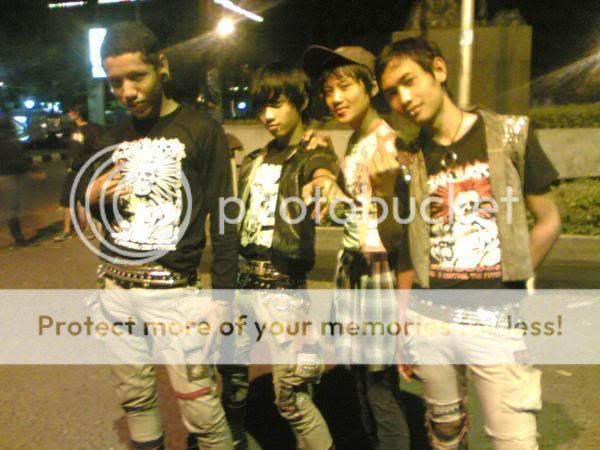
The classic punk rock look among male U.S. musicians harkens back to the T-shirt, motorcycle jacket, and jeans ensemble favored by American greasers of the 1950s associated with the rockabilly scene and by British rockers of the 1960s. The cover of the Ramones' 1976 debut album, featuring a shot of the band by Punk photographer Roberta Bayley, set forth the basic elements of a style that was soon widely emulated by rock musicians both punk and nonpunk.[2] Richard Hell's more androgynous, ragamuffin look—and reputed invention of the safety-pin aesthetic—was a major influence on Sex Pistols impresario Malcolm McLaren and, in turn, British punk style.[33][34] (John Morton of Cleveland's Electric Eels may have been the first rock musician to wear a safety-pin-covered jacket.)[35] McLaren's partner, fashion designer Vivienne Westwood, credits Johnny Rotten as the first British punk to rip his shirt, and Sex Pistols bassist Sid Vicious as the first to use safety pins.[36] Early female punk musicians displayed styles ranging from Siouxsie Sioux's bondage gear to Patti Smith's "straight-from-the-gutter androgyny".[37] The former proved much more influential on female fan styles.[38] Over time, tattoos, piercings, and metal-studded and -spiked accessories became increasingly common elements of punk fashion among both musicians and fans, a "style of adornment calculated to disturb and outrage".[39] The typical male punk haircut was originally short and choppy; the Mohawk later emerged as a characteristic style.[40] Those in hardcore scenes often adopt a skinhead look.
UK punks, circa 1986
The characteristic stage performance style of male punk musicians does not deviate significantly from the macho postures classically associated with rock music.[41] Female punk musicians broke more clearly from earlier styles. Scholar John Strohm suggests that they did so by creating personas of a type conventionally seen as masculine: "They adopted a tough, unladylike pose that borrowed more from the macho swagger of sixties garage bands than from the calculated bad-girl image of bands like The Runaways."[37] Scholar Dave Laing describes how bassist Gaye Advert adopted fashion elements associated with male musicians only to generate a stage persona readily consumed as "sexy".[42] Laing focuses on more innovative and challenging performance styles, seen in the various erotically destabilizing approaches of Siouxsie Sioux, The Slits' Ari Up, and X-Ray Spex' Poly Styrene.[43]
The lack of emphatic syncopation led punk dance to "deviant" forms. The characteristic style was originally the pogo.[44] Sid Vicious, before he became the Sex Pistols' bassist, is credited with initiating the pogo in Britain as an attendee at one of their concerts.[45] Moshing is typical at hardcore shows. The lack of conventional dance rhythms was a central factor in limiting punk's mainstream commercial impact.[46]
Breaking down the distance between performer and audience is central to the punk ethic.[47] Fan participation at concerts is thus important; during the movement's first heyday, it was often provoked in an adversarial manner—apparently perverse, but appropriately "punk". First-wave British punk bands such as the Sex Pistols and The Damned insulted and otherwise goaded the audience into intense reactions. Laing has identified three primary forms of audience physical response to goading: can throwing, stage invasion, and spitting or "gobbing".[48] In the hardcore realm, stage invasion is often a prelude to stage diving. In addition to the numerous fans who have started or joined punk bands, audience members also become important participants via the scene's many amateur periodicals—in England, according to Laing, punk "was the first musical genre to spawn fanzines in any significant numbers".[49]
Rabu, 21 Maret 2012

CARI DI SINI
CATEGORIES
Etc. (24)
He's Name Mozart (6)
Langkah Ku (11)
Musik (30)
Puisi (12)
Radio Musik Online (1)
software (5)
Talang Ubi Pendopo (34)
Tips "n" Triks Sharing (11)
Yang Telah Sirna (8)
PENGUNJUNG
Website Hit Counters
TOTAL PAGEVIEWS
40387
FOLLOWERS
TIME'S & DATE'S
Powered by Blogger.
Penemuan Mayat Korban Pembunuhan
Talang Ubi Pendopo 04/2/12...
Tragis, kota Pendopo dihebohkan dengan ditemukannya mayat seorang laki - laki di sebuah Tank air dekat Masjid Alfalah Komperta Pendopo. Saat ditemukan kondisi korban sulit dikenali karena kondisinya tersebut telah membusuk penuh belatung dan sudah mulai menjadi tengkorak.
Setelah di usut dan menurut informasi, mayat yang ditemukan tersebut di duga akibat pembunuhan dan merupakan salah satu siswa SMK YPIP Pendopo bernama Yulis Prasetyo yang beberapa hari ini memang meninggalkan/minggat dari rumahnya yg berlokasi di Bhayangkara. Hal ini diperkuat dengan keterangan dari keluarga korban setelah melihat dari ciri - ciri pakaian yang dikenakan oleh korban.
Pelaku diperkirakan masih teman korban sendiri, dan polisi masih mengusut kasus tersebut dan apa motif dari pembunuhan ini. Semoga pihak Kepolisian bisa mengungkap kasus ini.
DIPOSKAN OLEH FAISAL_415Z
LABEL: TALANG UBI PENDOPO
7 KOMENTAR:
Aditya Darma said...
Nice Info Lorr..
cz lg d PLG jd dpet kbar simpang siurr
SUNDAY, FEBRUARY 05, 2012 11:35:00 AM
Riduan kartawijaya said...
Jaga diri jangan keluyuran untuk warga pendopo tercinta
SUNDAY, FEBRUARY 05, 2012 7:13:00 PM
Saya Adalah Bagus said...
thx info ny
SUNDAY, FEBRUARY 05, 2012 7:40:00 PM
Saya Adalah Bagus said...
thx info ny gan
SUNDAY, FEBRUARY 05, 2012 7:41:00 PM
Anonymous said...
Semoga pelakunya segera di tangkap dan dihukum seberat-beratnya dan semoga Yulis Prasetyo masuk surga karena mati sahid
MONDAY, FEBRUARY 06, 2012 2:10:00 PM
Sendy said...
Buat pak Polisi yg bertugas di Pendopo harus cepat thu bertindak jgn sampai banyak yg menjadi korban di sana, N jgn tidur az!!!!
MONDAY, FEBRUARY 06, 2012 4:40:00 PM
merah putih said...
be carefull every ..one
THURSDAY, FEBRUARY 09, 2012 12:53:00 AM
POST A COMMENT
Masukkan Nama / Jati Diri Bila Ingin Berkomentar dengan klik pilih profile pada kolom di bawah... Demi Terikatnya Silahturahmi...
CATEGORIES
Etc. (24)
He's Name Mozart (6)
Langkah Ku (11)
Musik (30)
Puisi (12)
Radio Musik Online (1)
software (5)
Talang Ubi Pendopo (34)
Tips "n" Triks Sharing (11)
Yang Telah Sirna (8)
PENGUNJUNG
Website Hit Counters
TOTAL PAGEVIEWS
40387
FOLLOWERS
TIME'S & DATE'S
Powered by Blogger.
Penemuan Mayat Korban Pembunuhan
Talang Ubi Pendopo 04/2/12...
Tragis, kota Pendopo dihebohkan dengan ditemukannya mayat seorang laki - laki di sebuah Tank air dekat Masjid Alfalah Komperta Pendopo. Saat ditemukan kondisi korban sulit dikenali karena kondisinya tersebut telah membusuk penuh belatung dan sudah mulai menjadi tengkorak.
Setelah di usut dan menurut informasi, mayat yang ditemukan tersebut di duga akibat pembunuhan dan merupakan salah satu siswa SMK YPIP Pendopo bernama Yulis Prasetyo yang beberapa hari ini memang meninggalkan/minggat dari rumahnya yg berlokasi di Bhayangkara. Hal ini diperkuat dengan keterangan dari keluarga korban setelah melihat dari ciri - ciri pakaian yang dikenakan oleh korban.
Pelaku diperkirakan masih teman korban sendiri, dan polisi masih mengusut kasus tersebut dan apa motif dari pembunuhan ini. Semoga pihak Kepolisian bisa mengungkap kasus ini.
DIPOSKAN OLEH FAISAL_415Z
LABEL: TALANG UBI PENDOPO
7 KOMENTAR:
Aditya Darma said...
Nice Info Lorr..
cz lg d PLG jd dpet kbar simpang siurr
SUNDAY, FEBRUARY 05, 2012 11:35:00 AM
Riduan kartawijaya said...
Jaga diri jangan keluyuran untuk warga pendopo tercinta
SUNDAY, FEBRUARY 05, 2012 7:13:00 PM
Saya Adalah Bagus said...
thx info ny
SUNDAY, FEBRUARY 05, 2012 7:40:00 PM
Saya Adalah Bagus said...
thx info ny gan
SUNDAY, FEBRUARY 05, 2012 7:41:00 PM
Anonymous said...
Semoga pelakunya segera di tangkap dan dihukum seberat-beratnya dan semoga Yulis Prasetyo masuk surga karena mati sahid
MONDAY, FEBRUARY 06, 2012 2:10:00 PM
Sendy said...
Buat pak Polisi yg bertugas di Pendopo harus cepat thu bertindak jgn sampai banyak yg menjadi korban di sana, N jgn tidur az!!!!
MONDAY, FEBRUARY 06, 2012 4:40:00 PM
merah putih said...
be carefull every ..one
THURSDAY, FEBRUARY 09, 2012 12:53:00 AM
POST A COMMENT
Masukkan Nama / Jati Diri Bila Ingin Berkomentar dengan klik pilih profile pada kolom di bawah... Demi Terikatnya Silahturahmi...
Rabu, 14 Maret 2012
kisah punk rock jalanan

Kisah Sang Punk Rock Jalanan

"Cerita Punk Rock Jalanan"
(kisah ini Terinspirasi dari kisah nyata)
Tersebutlah seorang pemuda berusia 15 tahun. Namanya Tigor bersekolah kelas 3 SMP Kartika Balikpapan. Lahir di keluarga baik-baik. Konon ceritanya keluarganya yang tadinya kaya-raya mendadak jatuh miskin karena perusahaan sang ayah yang bergerak di bidang kontraktor sipil gulung tikar. Di tengah hobinya bergabung dengan klub BMX, Tigor tidak dapat memenuhi kebutuhannya untuk menyalurkan hobinya itu lebih dalam…yaitu memakai barang-barang bermerk di tubuhnya, membeli ornamen-ornamen untuk sepedanya, dan sebagainya. Belum lagi ejekan dari teman-teman satu klub yang selalu diterimanya. Sementara di satu sisi, terdapat sebuah klub juga yang menamai diri mereka ‘street guys‘. Dalam jiwanya yang labil, Tigor akhirnya membelot. Anak-anak ‘street‘ jiwa kekeluargaannya lebih besar dibanding anak-anak BMX yang berasal dari keluarga ‘berada’. Tigor mulai merokok, bahkan untuk anak seusianya yang masih tergolong belia, ia sudah mulai mengenal alkohol. Orang tuanya tak henti-henti menasehatinya, tapi doktrin punk terlalu kuat…isinya antara lain "Nazi fuck…polisi anjing…kita bukan budak, jangan mau disuruh-suruh…kami anti kemapanan!!!".
Orang tuanya hanya bisa mengurut-urut dada saja ketika Tigor membantah sewaktu disuruh membuang sampah rumah tangga mereka di tempat pembuangan sampah yang tidak begitu jauh dari rumahnya. Hingga suatu waktu sang ayah marah besar ketika Tigor membentak beliau hanya karna disuruh pergi ke warung makan. Kemarahan sang ayah membuat Tigor begitu sakit hati karena Tigor belum pernah melihat sang ayah semarah itu kepadanya. Tigor pergi dari rumah tanpa membawa baju ganti satupun. Ia pergi bersama kumpulan barunya yaitu ‘street guys‘ ato lebih kita kenal dengan nama anak punk yang sesungguhnya keberadaan mereka sangat meresahkan masyarakat sekitar dan selalu membuat para polisi jengkel. Di sinilah petualangan Tigor dimulai. Bersama kumpulan barunya ia ikut mengamen di lampu merah, jika lapar dan tidak cukup uang ia mentegakan dirinya mengorek-ngorek tempat sampah demi mengobati perutnya yang sangat kelaparan. Sementara ayah dan ibunya menangis berhari-hari di rumah, berharap Tigor, anak laki-laki satu-satunya mereka segera pulang ke rumah. Tigor memiliki seorang kakak perempuan yang kemudian diasuh oleh tantenya setelah mereka jatuh miskin.
Akhirnya suatu saat ibunya mendapati anak lelakinya itu sedang mengorek sebuah tong sampah. Kulitnya bertambah hitam, tubuh jangkungnya terlihat semakin kurus, rambutnya yang hitam legam bagus berubah menjadi model mohawk yang tak beraturan dan berwarna merah yang entah mungkin dari cat rambut murahan. Ibunya menangis melihat anaknya itu dan memintanya pulang ke rumah. Tapi Tigor tetap membantah sampai akhirnya temannya membujuknya untuk pulang…dan pulanglah ia. Ayahnya mulai mengalah padanya. Motor satu-satunya yang tersisa di rumah itu khusus untuk Tigor pakai. Tigor mulai mau sekolah lagi, tapi di akhir pekan, tak ada yang bisa menghalangi langkahnya untuk pergi ke Samarinda, 2 setengah jam dari Balikpapan waktu tempuhnya, bersama anak-anak punk. Namun ayah dan ibunya tak begitu khawatir karena di Samarinda banyak tante-tante dan sepupunya. Sampai akhirnya ia berkenalan dengan seorang gadis kelas 3 SMP di SMPN 2 Samarinda bernama Liza. Kebetulan Liza adalah teman satu sekolah sepupunya. Tigor pulang ke Balikpapan dengan hati berbunga-bunga. Bertambah rajinlah ia berkunjung ke Samarinda karena gadis bernama Liza ini. Orang tuanya sungguh khawatir sesuatu terjadi padanya sepanjang perjalanan lintas kota itu.
Akhirnya kelulusan tiba juga. Tigor masuk ke STM Swasta satu-satunya di Balikpapan, jurusan elektro. Belum selesai cobaan yang harus Tigor dan keluarganya terima, berawal dari kecurigaan kedua orang tuanya kalau si anak buta warna karena Tigor sangat susah membedakan antara warna merah muda dan hijau, ditambah lagi dengan sang ayah adalah seorang yang buta warna. Akhirnya keluarga membawanya ke puskesmas, namun kata puskesmas hanyalah kurang latihan. Oleh karena itu kedua orang tuanya tetap nekad memasukkan ke STM yang terdekat dari rumahnya.Namun karena sudah dilatih berulang-ulang si Tigor belum juga bisa menghafal warna-warna tersebut, dengan bantuan sang tante, kemudian Tigor kembali untuk melakukan pemeriksaan dan dibawa ke dokter spesialis mata. Tigor dinyatakan buta warna parsial (60%). Bermaksud baik, sang ibu membawa surat pernyataan dari dokter itu ke pihak sekolahnya agar anaknya dipindahkan jurusan ke jurusan otomotif saja. Ternyata pihak sekolah malah beranggapan bahwa anak buta warna sama sekali tidak bisa masuk di STM di jurusan apapun, jadi lebih baik pindah ke sekolah umum saja. Padahal STM tersebut sebelumnya tidak melakukan test buta warna terhadap calon-calon siswanya maupun meminta surat pernyataan tidak buta warna terlebih dahulu dari para calon siswanya, seperti yang dilakukan oleh STM negeri. Di sekolah teman-teman memperlakukannya seperti orang yang dikucilkan, sikap sang guru juga kurang baik kepadanya (karena Tigor memang bukan siswa teladan di sekolahnya). Akhirnya Tigor membuat keputusan untuk berhenti sekolah. Ia hanya mempunyai ijazah SMP dan tambah menjadi-jadi kehidupan malam dijalaninya di usianya yang baru 16 tahun itu. Suatu hari yang paling membuat orang tuanya shock adalah Tigor yang baru pulang dari Samarinda, membawa Liza pacarnya ke rumah. Saat itu memang sang kakak sedang nginap juga di rumahnya. Ketika ditanya oleh orang tuanya, katanya si Liza akan menginap semalam, mau jalan-jalan dulu di Balikpapan, tidurnya bareng kakaknya saja. Ketika orang tuanya menanyai Liza apakah sudah ijin kepada orang tuanya, Liza bilang sudah. Walau masih sedikit curiga karena Liza masih menggunakan seragam pramuka, namun orang tua Tigor cukup lega karena menurut Liza ia sudah meminta ijin sebelum ke Balikpapan. Sampai kemudian terjadi kehebohan besar.
Tantenya Tigor telpon ke rumah menanyai Tigor tentang keberadaan Liza karena orang tua Liza membuat ribut di rumah tantenya tersebut. Ketika mengetahui Tigor membawa Liza ke Balikpapan, tantenya langsung menyuruh mamanya Liza berbicara sendiri kepada ibunya Tigor. Ibu meminta mamanya Liza untuk tidak terlalu khawatir, namun mamanya Liza tetap bersikukuh meminta alamat Tigor di Balikpapan. Di tengah tidur pulasnya Liza, jam 4 subhu, orang tuanya menjemput menggunakan taxi argo. Mereka tampak sangat khawatir karena Liza adalah anak semata-wayang mereka. Akhirnya Liza dilarang orang tuanya menemui Tigor lagi. Tigor datang ke Samarinda sudah tidak disambut baik lagi oleh keluarganya Liza. Orang tua Liza tidak suka Tigor bergaul dengan Liza karena Tigor hanyalah seorang yang lulusan SMP, dan seorang punker. Liza berasal dari keluarga kaya. Tigor patah hati berat dengan Liza. Tigor mencoba untuk bunuh diri, namun teman-teman satu kumpulannya mencegahnya. Kehidupan Tigor tambah lekat pada kehidupan punk. Waktunya habis untuk mengamen dan berkumpul bersama anak-anak punk di jalanan. Puskib adalah tempat berkumpulnya mereka. Lampu merah adalah tempat mereka mengamen. Lagu andalan anak-anak punk berjudul "Punk Rock Jalanan".
Lagu itu selalu Tigor nyanyikan saat mengamen, karena Tigor merasa bahwa lagu itu sangat sesuai untuknya, dia memang seorang "Punk Rock Jalanan". Sewaktu orang tuanya memohonnya melepaskan diri dari punk, Tigor berkata, "Bu, mereka juga keluargaku. Sewaktu motorku kehabisan bensin di kilometer 20-an, di tengah hutan sana, aku menghubungi seorangpun temanku tak ada yang bisa datang menolongku, tapi ketika aku menelpon Dedy, salah seorang teman punk, semua anak punk Balikpapan datang menghampiriku, jalan kaki mereka dari kota demi aku, menemaniku mendorong motor sampai aku bisa mengisi bensin motorku. Aku menangis dalam hati saat itu. Karena sebenarnya saat itu aku sudah ingin lepas dari mereka. Saat Liza meninggalkanku, punk tidak pernah meninggalkanku."
Orang tuanya terharu dan tidak sanggup berkata apapun lagi. Punk memang meresahkan masyarakat, mungkin karena mereka terkesan urakan, tapi sikap kekeluargaan mereka terhadap sesamanya patut diacungi jempol. Begitulah kisah Tigor, Punk Rock Jalanan.
Langganan:
Komentar (Atom)